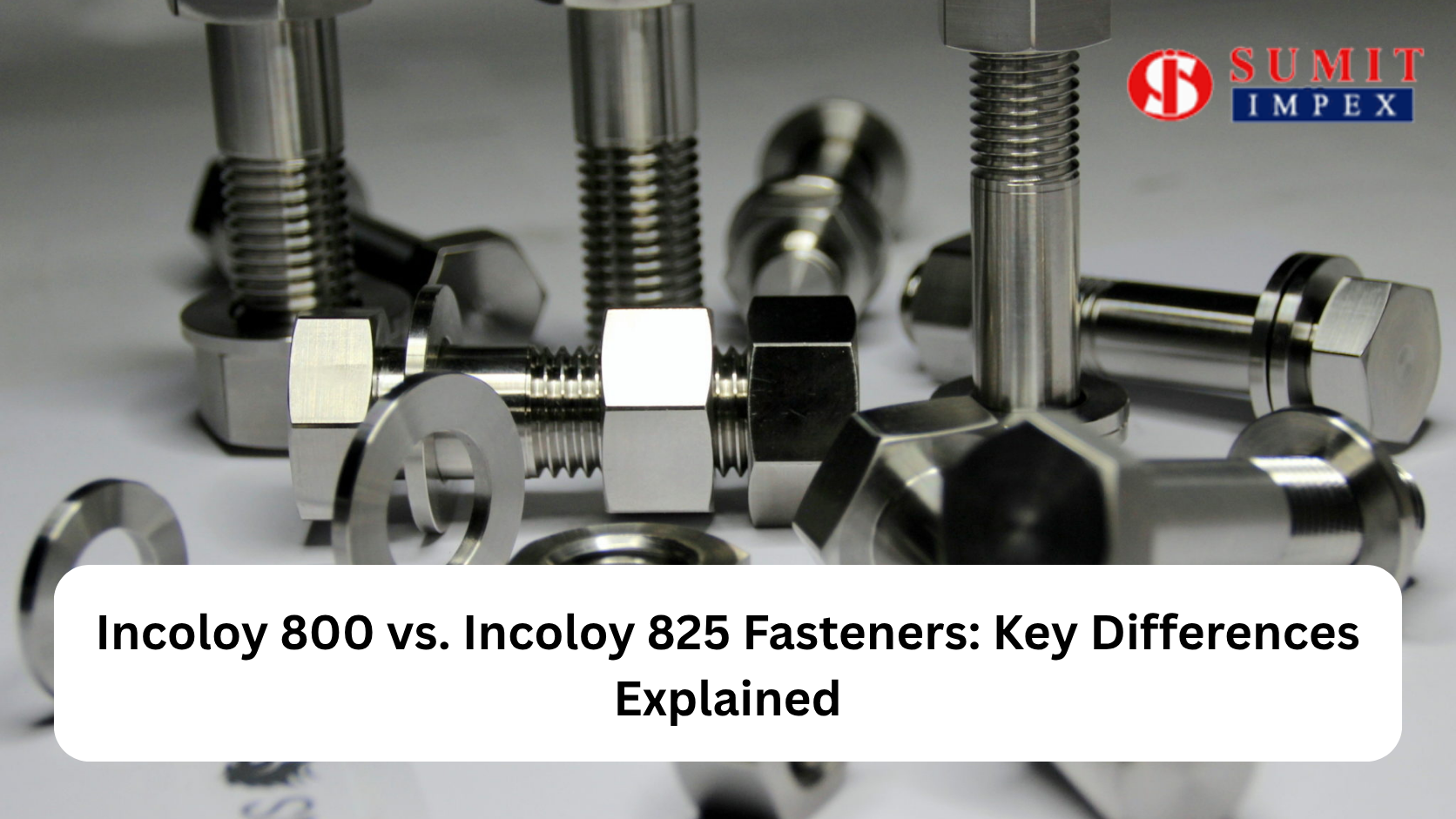
Incoloy 800 Fasteners and Incoloy 825 fasteners share a nickel-iron-chromium base but are used for distinct industrial applications. Incoloy 800 is manufactured to maintain stability in high-temperature environments, whereas Incoloy 825 offers superior protection against harsh acids and chlorides. Choosing the wrong grade based only on the immediate availability can reduce equipment lifespan and increase maintenance costs. This blog compares both grades, analyzing their chemical composition, corrosion resistance, temperature capabilities, and helps buyers choose the right Incoloy 800 Fasteners or 825 fasteners for their specific project needs.
What are Incoloy 800 and Incoloy 825 Fasteners?
Incoloy 800 fasteners are machined from UNS N08800, a nickel-iron-chromium alloy with 30 to 35% nickel, 19 to 23% chromium and iron near 40% of the composition. Small aluminium and titanium additions, 0.15 to 0.60% each, give it stability at elevated temperature. Incoloy 825 fasteners come from UNS N08825, a related grade with higher nickel (38 to 46%) plus molybdenum and copper that shift its strength toward corrosion service. Both sit under the broader category of alloy fasteners used where standard stainless bolting corrodes or softens too quickly, spanning furnace equipment, chemical plants and offshore installations.
Incoloy 800 vs. Incoloy 825 Fasteners: Key Differences
Six factors separate these grades in practical terms: composition, corrosion resistance, high-temperature performance, mechanical properties, applications and cost.
Chemical Composition
Incoloy 800 relies on chromium for oxidation resistance and iron for internal oxidation resistance, with nickel keeping the structure ductile. Incoloy 825 adds 2.5 to 3.5% molybdenum and 1.5 to 3.0% copper on a similar chromium base. Those additions push 825 toward acid resistance 800 was never designed to provide.
Corrosion Resistance
Nickel content gives both grades resistance to chloride stress-corrosion cracking, but the similarity ends there. Incoloy 800 can sensitise between 540°C and 760°C like most austenitic alloys. Incoloy 825 does better: molybdenum resists pitting and crevice attack, copper resists sulphuric and phosphoric acid, and titanium stabilises against intergranular corrosion. Sour wells and acid plants favour 825.
High-Temperature Performance
Incoloy 800 is the grade built for heat, holding usable tensile strength for continuous service to about 816°C (1500°F) and avoiding the embrittling sigma phase after prolonged exposure near 649°C (1200°F). That is why furnace baskets and cracker tube hardware specify this grade. Incoloy 825 is rated only to roughly 550°C (1020°F); beyond that, its acid resistance offers no advantage.
Mechanical Properties
Incoloy 825 fasteners carry higher room-temperature strength, with minimum tensile strength around 586 MPa (85 ksi) and minimum yield strength near 241 MPa (35 ksi). Incoloy 800 runs lower in the annealed condition but keeps useful strength past the point where standard stainless bolting softens. Neither grade strengthens through precipitation hardening; both rely on solid-solution effects and, for 825, cold work.
Typical Applications
Furnace and reactor hardware call for Incoloy 800 fasteners: cracking furnaces, radiant tube supports and carburising baskets. Incoloy 825 fasteners secure phosphoric acid evaporators, desulphurisation scrubbers, seawater piping and sour-service wellheads qualified to NACE MR0175.
Cost Considerations
Incoloy 825’s higher nickel, molybdenum and copper content puts it above Incoloy 800 on raw material cost. That gap narrows once lifecycle cost enters the picture: a fastener that fails from pitting or cracking costs far more than the price difference ever saved. Matching grade to environment, not price, determines long-term value.
Also read: Inconel vs Incoloy Fasteners: A Comprehensive Comparison
How to Choose the Right Incoloy Fastener?
Start with operating temperature. If service runs above roughly 550°C, Incoloy 800 is the only one of the two built for it. Below that, look at the corrosive environment: chlorides, sulphuric acid or phosphoric acid point toward Incoloy 825. Match the grade to the governing failure mode, not the nearest stock item, and confirm the choice against the relevant ASTM specification, B408 for 800, B425 or B564 for 825.
Industries Using Incoloy Alloy Fasteners
Alloy fasteners in these grades show up across chemical processing, oil and gas, petrochemical plants, marine engineering, power generation and pollution control. Chemical and petrochemical plants need resistance to heat, acid, or both, depending on the process stage. Oil and gas operators specify 825 for sour service compliance. Marine systems need chloride resistance standard stainless bolting cannot deliver. Desulphurisation units rely on 825’s acid resistance, while furnace hardware in the same plants often calls for 800.
Conclusion
Incoloy 800 and Incoloy 825 fasteners come from the same alloy family but solve opposite problems: one for sustained heat, one for aggressive corrosion. Composition, corrosion resistance and temperature rating decide the right grade, not price alone. Getting it right the first time avoids premature failure and downtime. Sumit Impex supplies both Incoloy 800 Fasteners and Incoloy 825 fasteners to ASTM specification with full mill test certification. Contact Sumit Impex to confirm the right grade for your application.
Related Posts