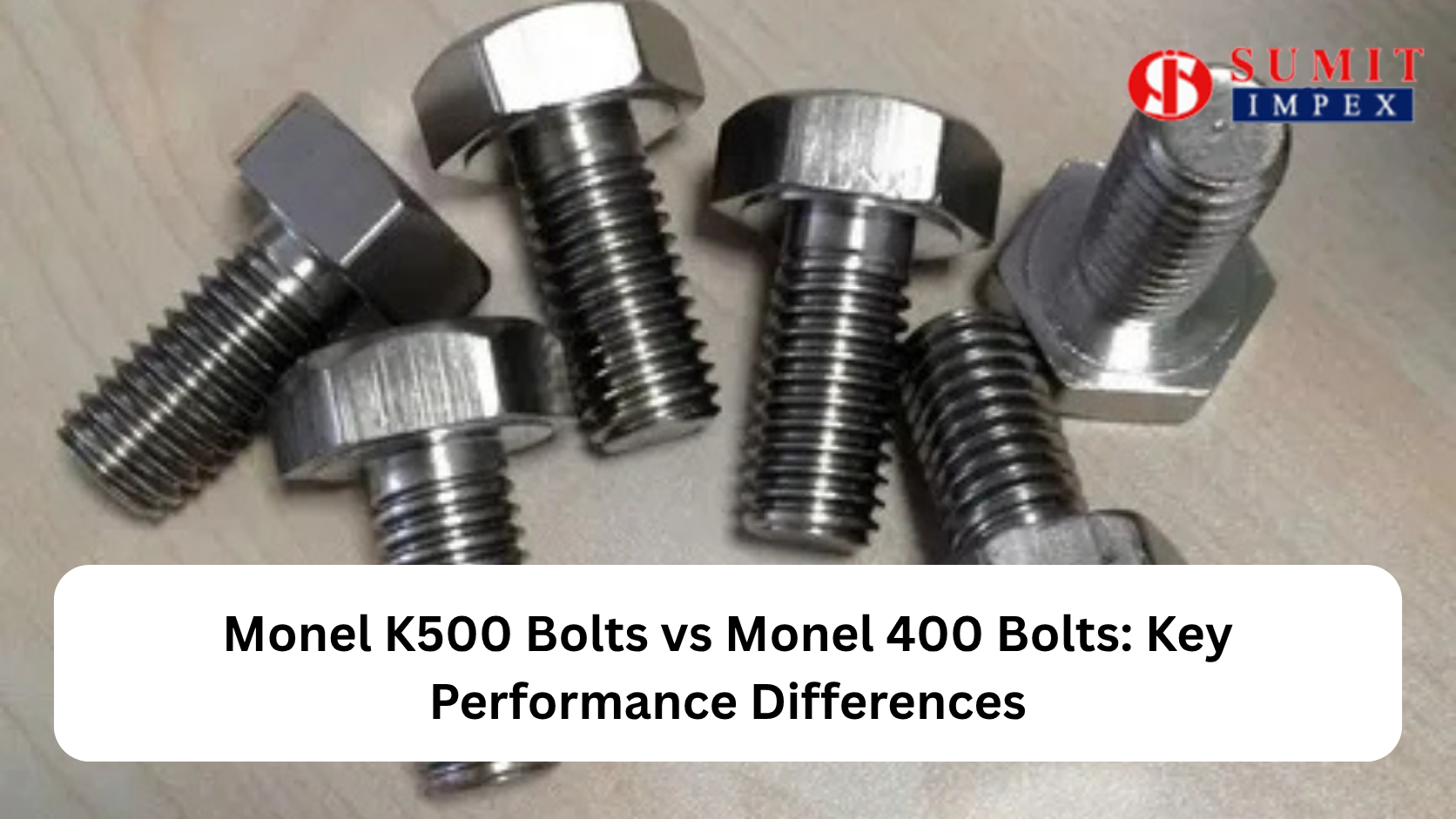
Fastening systems in seawater and high-chloride service fail more often at the bolt than anywhere else in the assembly. Monel alloys solved that problem decades ago by combining nickel and copper into fasteners that resist chloride attack and stress corrosion cracking far better than stainless steel. Two grades dominate procurement decisions: Monel K500 and Monel 400. Picking the wrong one costs more than money. It risks bolt failure at a flange joint that nobody inspects until a leak occurs. This comparison breaks down where each grade actually performs better.
What Are Monel K500 Bolts?
Monel K500 bolts draw their strength from age hardening, a heat treatment that precipitates aluminum and titanium compounds through the nickel-copper matrix. That process pushes tensile strength past 900 MPa while retaining the base alloy’s resistance to seawater and acidic media. Oil field tool joints, pump shafts, and subsea fastener assemblies rely on this grade. Buyers sourcing this alloy through a Monel K500 bolts supplier need the extra 300 to 400 MPa of yield strength that standard Monel 400 cannot deliver.
What Are Monel 400 Bolts?
Monel 400 bolts come from the original nickel-copper alloy developed for marine hardware, holding roughly 63 to 70 % nickel and 28 to 34 % copper without any age-hardening additions. That composition gives it strong resistance to seawater, hydrofluoric acid, and alkaline solutions, along with tensile strength around 550 to 620 MPa in the annealed condition. Chemical processing lines, desalination plants, and marine piping systems specify this grade where corrosion resistance matters more than raw strength. When a project calls for dependable weldability alongside proven corrosion performance, Monel 400 bolts remain the practical choice over the harder K500 variant.
Key Performance Differences Between Monel K500 Bolts and Monel 400 Bolts
Both grades share a nickel-copper base, yet age hardening changes everything downstream. These six factors separate Monel K500 bolts from Monel 400 bolts in real service.
Strength and Load Bearing Capacity
Age hardening lifts Monel K500’s yield strength to 590 to 790 MPa, nearly triple Monel 400’s 240 MPa figure. Heavy-duty flange bolting, high-torque assemblies, and subsea connectors depend on that reserve capacity under sustained load.
Corrosion Resistance
Both alloys resist seawater and hydrofluoric acid to a similar degree since corrosion resistance comes from the base nickel-copper chemistry, not the hardening additions. Monel 400 suits static immersion; K500 handles corrosive environments under mechanical stress.
Wear and Galling Resistance
Monel K500’s higher hardness, Rockwell C 24 to 35, against Monel 400’s Rockwell B 65 to 85, cuts thread galling on assembly and disassembly. Pump shafts, valve stems, and threaded assemblies that see repeated cycling favor K500 for this reason.
Temperature Performance
Both alloys stay ductile down to −196°C without embrittlement, suiting cryogenic service. K500 holds its aged strength up to roughly 480°C, while Monel 400 tolerates higher exposure since it carries no precipitate structure to overage.
Machinability and Fabrication
Monel 400 machines more easily in the annealed state, cutting tool wear and cycle time on high-volume runs. K500 demands rigid tooling and slower feeds because its hardness resists standard turning and threading operations.
Service Life and Maintenance
K500 bolts hold torque longer in vibration-prone assemblies, reducing retightening intervals. Monel 400 needs less specialized machining support over its service life but loses clamp load faster at dynamic-load fastening points.
Monel K500 Bolts vs Monel 400 Bolts: Quick Comparison Table
The figures below summarize composition, mechanical strength and service limits side by side, giving procurement teams a quick reference before specifying either grade for a given application.
| Parameter | Monel K500 Bolts | Monel 400 Bolts |
| Strengthening method | Precipitation (age) hardening | Solid-solution, cold work only |
| Tensile strength | 900 to 1050 MPa | 550 to 620 MPa |
| Yield strength | 590 to 790 MPa | 240 to 280 MPa |
| Hardness | Rockwell C 24 to 35 | Rockwell B 65 to 85 |
| Galling resistance | High | Moderate |
| Machinability | Harder, needs rigid tooling | Easier, standard tooling |
| Max continuous service temp | ~480°C | ~600°C (non-critical load) |
| Recommended use | High-load, dynamic assemblies | Static corrosion-resistant fastening |
Conclusion
Monel K500 bolts deliver higher strength, better galling resistance, and stronger performance in dynamic loading. Monel 400 bolts machine faster and cost less where static corrosion resistance is the priority. The right pick depends on load, motion and budget. At Sumit Impex, we supply both grades from Mumbai; reach out to us for current stock and pricing.
Related Posts