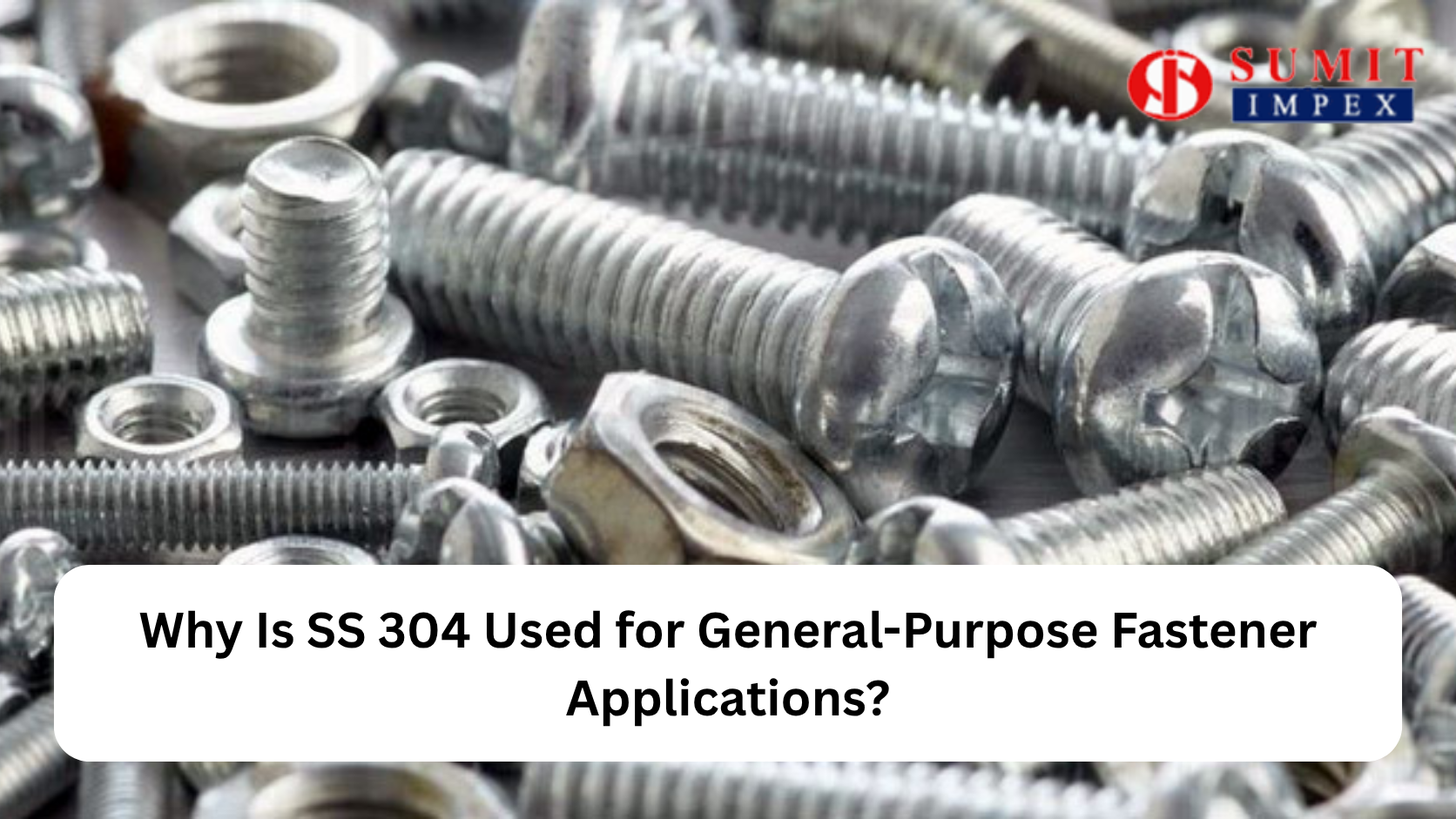
SS 304 fasteners turn up everywhere, construction sites, food processing units, general machinery assembly, and there is a simple reason for that. The mix of corrosion resistance, strength, and cost works out better than most alternatives in the same price bracket. This austenitic grade handles ordinary atmospheric and damp conditions without the price tag of premium alloys. Stock availability helps too; most stockists carry it in standard sizes. Even so, the environment and service conditions of a project should still be checked before settling on the grade.
What Makes SS 304 Suitable for Fasteners?
Stainless Steel 304 fasteners contain around 18% chromium and 8% nickel. That composition gives it an austenitic structure, non-magnetic and ductile at room temperature. A passive chromium oxide layer forms on the surface, and it repairs itself if scratched during installation. Tensile strength sits around 505 MPa annealed, enough for most structural connections. It also cold-forms without cracking, so manufacturing costs stay low, and that is why fabricators reach for it as the default option.
Key Properties of SS 304 Fasteners
Three properties matter most for how SS 304 fasteners perform once installed: resistance to corrosion, mechanical reliability, and how easily they can be fabricated into different fastener types.
Corrosion Resistance
Grade 304 resists rain and atmospheric humidity without additional coatings. Marine air and de-icing salt require Grade 316 to prevent severe pitting corrosion.
Strength and Durability
Yield strength sits near 215 MPa, tensile strength around 505 MPa, enough to hold threaded connections steady under vibration and repeated loading. General structural work, equipment assembly, and mechanical fastening across a range of loads all fall within this.
Formability and Fabrication
The ductility in SS 304 allows cold heading, thread rolling, and machining without much tool wear. Nuts, bolts, screws, washers, and threaded rods all get shaped from it at consistent tolerances.
Why Is SS 304 Preferred for General-Purpose Fastening?
Procurement teams favour SS 304 largely because it works across construction, food processing, automotive and architectural jobs without needing a grade change for each one. It costs less than nickel-heavy alloys and performance still covers most indoor and outdoor conditions with little maintenance. Standard warehouses stock it in metric and imperial sizes, so lead times don’t drag. Engineers specify it by default once conditions sit within its corrosion tolerance, since price, availability and durability together cut procurement effort and upkeep.
Where Are SS 304 Fasteners Commonly Used?
A few industries lean on SS 304 fasteners where moderate corrosion resistance and standard availability matter more than chemical resistance.
- Construction projects use SS 304 fasteners for structural framing, cladding panels and building assemblies.
- Food processing plants use SS 304 nuts and bolts because they resist staining from washdowns and mild acids.
- Machinery manufacturers fasten equipment housings and moving assemblies with SS 304 bolts rated for cyclic loads.
- Architectural fabricators use SS 304 screws and washers on railings, facades and visible exterior fittings.
- Automotive and transport builders fit SS 304 fasteners on components facing moderate road exposure and vibration.
- Plumbing contractors use SS 304 threaded rods and fittings in water systems free of chloride content.
- Temperature, chemical exposure, and load vary by project, so these need checking before ordering; otherwise, fasteners fail earlier than expected.
SS 304 vs Other Stainless Steel Grades for Fastening
SS 304 and SS 316 are close in mechanical properties, but corrosion resistance is where they part ways once chloride exposure gets involved. The table sets out the main differences worth checking first.
| Property | SS 304 | SS 316 |
| Chromium content | ~18% | ~16-18% |
| Nickel content | ~8% | ~10-14% |
| Molybdenum | None | 2-3% |
| Corrosion resistance | Good in atmospheric and mild chemical exposure | Higher resistance in chloride and marine environments |
| Typical use | General construction, food processing, machinery | Marine, chemical processing, pharmaceutical |
| Relative cost | Lower | Higher, due to molybdenum and nickel content |
Projects near coastal air, de-icing salts, or chemical processing lines usually prefer SS 316 Fasteners for the added molybdenum and pitting resistance. Choosing between the two should come down to documented service conditions, not habit or popularity.
How to Select a Reliable SS 304 Fastener Manufacturer?
Start by checking the material grade against ASTM A193, A320, or an equivalent standard on the mill test certificate. Nothing ships until dimensional accuracy, thread pitch and mechanical properties are consistent with the order spec. Quality is the result of documented testing and inspection, including tensile and hardness checks, in sample batches. Projects stay on schedule and on budget thanks to consistent supply regardless of size, finish and fastener type. The risk of providing the wrong specification to the site is reduced when working with a professional stainless steel fasteners manufacturer who knows the application-specific requirements.
Conclusion
SS 304 stays the default choice for general-purpose fastening because it brings together corrosion resistance, strength, easy fabrication, and lower cost in one grade. Getting the grade right still depends on the actual service conditions. Sumit Impex supplies SS 304 fasteners across standard sizes and finishes. Contact us for a quote on your project’s fastener requirements.
Related Posts