A bolted joint fails long before the equipment around it does, and corrosion at the threads causes most of that failure. Fasteners hold pressure boundaries, pipe supports, and structural skids together, so surface condition decides how long the whole assembly stays serviceable.
Buyers comparing surface treatments shortlist PTFE-coated fasteners in India before weighing them against plain alloy steel or stainless hardware. Coating choice changes three things on site: corrosion resistance, torque control, and how often crews replace bolting.
What Makes PTFE Coated Fasteners Different From Conventional Fasteners?
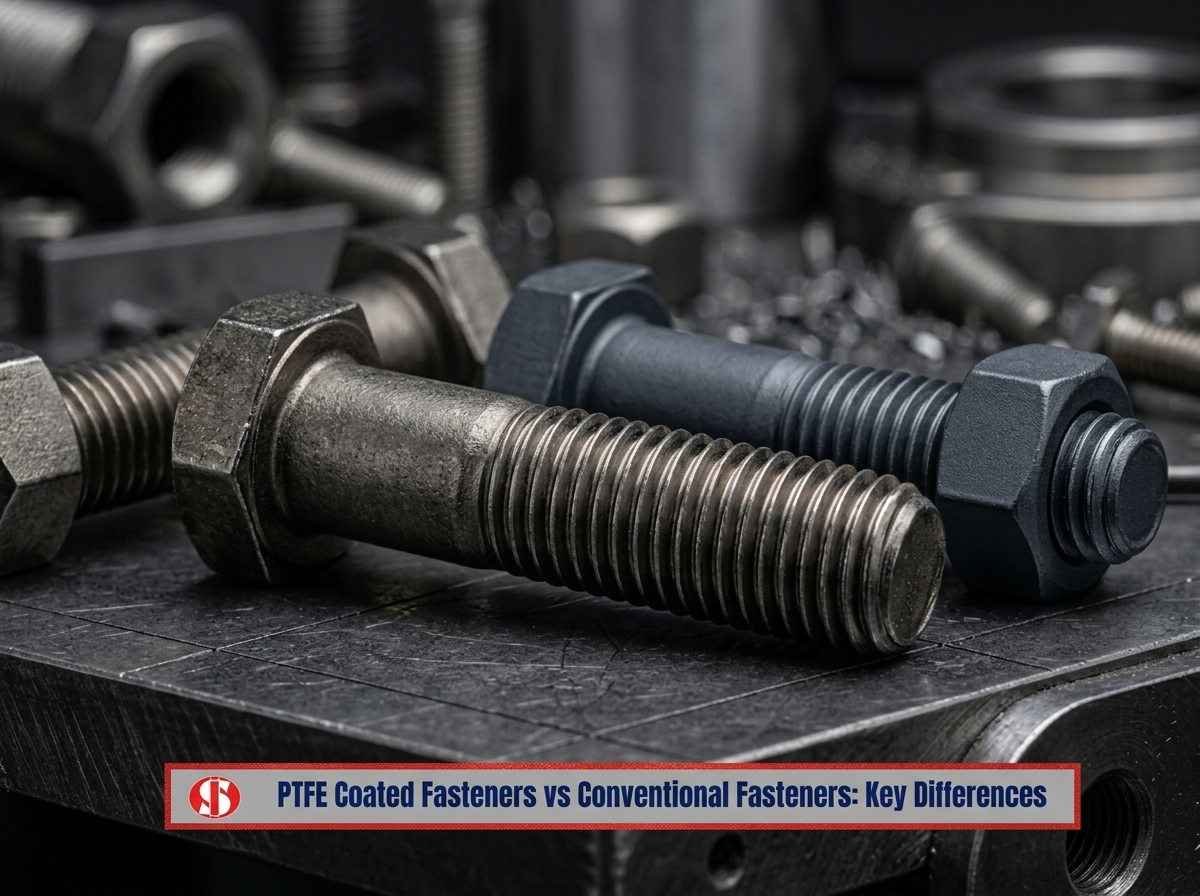
PTFE coating places a fluoropolymer film, 20 to 40 microns thick, across the head, shank, and threads of the fastener. Conventional fasteners ship plain, hot dip galvanized, or zinc electroplated, in grades such as ASTM A193 B7 carbon steel or austenitic SS 316. PTFE-coated fasteners perform differently because the film stops the base metal from touching the process media at all. Friction drops sharply as a result. Industrial facilities utilizing PTFE-coated bolts in offshore and chemical applications leverage the coating’s color to visually identify material grades in inventory, an advantage unavailable with uncoated hardware.
Corrosion Resistance Comparison
Salt spray testing separates the two categories quickly. Fluoropolymer-coated bolting clears 1,000 to 3,000 hours under ASTM B117 before red rust appears, while bare carbon steel shows corrosion within a day. The film blocks acids, alkalis, and chloride-bearing water, so pitting under the nut face slows down considerably. It also insulates dissimilar metals, which limits galvanic attack when ptfe coated bolts and nuts join a stainless flange to a carbon steel body.
Friction and Installation Performance
PTFE carries a coefficient of friction between 0.04 and 0.10, one of the lowest values available in any industrial coating. Torque behavior changes with it. Coated studs show a nut factor near 0.10 to 0.15 against 0.18 to 0.22 for uncoated steel, so engineers lower applied torque to reach the same preload. Stainless fasteners gall during tightening when thread surfaces weld under load, and the film prevents that contact. Removal after long service also stays possible without cutting, which matters on PTFE-coated stud bolts in flanged joints.
Service Life and Maintenance Requirements
Coated bolting on an offshore deck lasts 10 to 15 years against 2 to 5 years for galvanized hardware in the same splash zone. Replacement frequency drives the cost difference more than purchase price does. A single flange break to remove seized studs consumes scaffolding, hot work permits, crane time, and shutdown hours, and that expense exceeds the cost of the fasteners several times over. Although maintenance teams continue to inspect coated hardware, replacement requirements during scheduled turnarounds are significantly reduced.
PTFE Coated Fasteners vs Conventional Fasteners: Side-by-Side Comparison
The table below sets both options against ten parameters that engineers weigh during specification. Neither type suits every duty. Environment, planned maintenance interval, and total lifecycle cost decide which one earns its place in a given plant. Read the figures as service benchmarks, since coating quality and base grade both shift them.
Parameter | PTFE Coated Fasteners | Conventional Fasteners |
| Corrosion Resistance | 1,000 to 3,000 hours in ASTM B117 salt spray | 24 to 200 hours depending on plating |
| Chemical Resistance | Withstands acids, alkalis, solvents, and chlorides | Attacked by acids and chloride solutions |
| Coefficient of Friction | 0.04 to 0.10 | 0.15 to 0.35 |
| Anti-Galling Performance | Film separates thread flanks and prevents seizing | Stainless grades gall under high torque |
| Ease of Installation | Lower torque reaches target preload | Standard torque values apply |
| Service Life | 10 to 15 years in marine exposure | 2 to 5 years in the same exposure |
| Maintenance Requirements | Visual inspection, rare replacement | Frequent inspection and periodic renewal |
| Typical Applications | Offshore, chemical, subsea, effluent handling | Indoor structural, dry utility, general assembly |
| Initial Cost | 2 to 4 times higher per piece | Lowest purchase price |
| Lifecycle Cost | Lower once downtime and labour enter the calculation | Rises with every replacement cycle |
Applications Where PTFE Coated Fasteners Offer Advantages
Four industry groups account for most coated fastener demand, and each one shares a common problem of aggressive media combined with limited access for maintenance work.
Chemical Processing Plants
Reactor covers, pump casings, and acid line flanges expose bolting to spillage and vapor. The fluoropolymer film resists sulphuric and hydrochloric attack, so crews open joints years later without drilling out studs.
Marine and Offshore Structures
Splash zones combine salt water, oxygen, and cyclic wetting, which destroys galvanized hardware fast. Coated studs on riser clamps, boat landings, and deck modules survive that exposure and unbolt cleanly during platform inspections.
Oil and Gas Facilities
Wellhead equipment, subsea manifolds, and separator flanges demand bolting that holds preload for a decade. NORSOK-approved coatings meet this duty, and operators specify them across topside piping where hydrogen Sulphide is present.
Water Treatment and Power Generation
Effluent tanks, chlorination units, and cooling water headers keep fasteners permanently damp. Coated bolting resists chlorine dosing and condensate, while conventional hardware in the same location seizes within two maintenance cycles.
Factors to Consider When Choosing Between PTFE Coated and Conventional Fasteners
Five practical questions settle the specification long before price enters the discussion, and each one relates directly to how the joint will behave in service.
- Check the chemical exposure first, because chlorides, acids, and continuous moisture rule out plain carbon steel almost immediately.
- Confirm the operating temperature, since PTFE films hold up to roughly 260°C and degrade above that limit.
- Assess how often crews will open the joint, as coated threads release cleanly while corroded hardware demands cutting or drilling.
- Review the preload requirement carefully and recalculate torque values, because coated threads reach target tension at lower applied torque.
- Compare purchase price against ten-year replacement and downtime cost rather than treating the initial figure as the deciding number.
When Are PTFE Coated Fasteners the Better Choice?
Certain service conditions justify the higher price without much analysis, and experienced maintenance engineers recognize these situations from previous failures on similar equipment.
- Choose coated bolting for splash zones, chemical bunds, and any location where salt or process spillage reaches the threads regularly.
- Specify the coating on stainless assemblies that gall during tightening, since thread damage during installation wastes both time and material.
- Use coated hardware on equipment scheduled for routine dismantling, because clean removal protects flange faces and shortens shutdown duration.
- Select it wherever access costs exceed material costs, such as elevated pipe racks, subsea structures, and confined plant areas.
- Apply it on joints that must hold preload across a decade without inspection, particularly buried or insulated assemblies.
Conclusion
Corrosion resistance, friction behavior, and maintenance frequency separate the two fastener types more than any other factor. Conventional hardware still suits dry indoor duty at lower cost. Sumit Impex supplies PTFE-coated fasteners in stainless steel, carbon steel, and high nickel alloy grades from Mumbai. Among PTFE-coated bolt suppliers, specification support matters as much as stock availability.
Related Posts