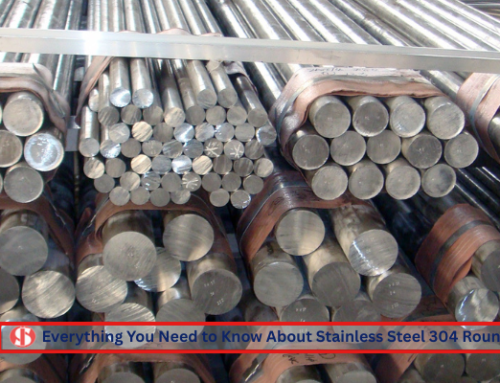

Introduction to Stainless Steel Round Bar
Stainless steel round bars are solid cylindrical bars of various grades of stainless steel. They are produced by hot-rolling, cold-drawing or forging, and serve as raw material for machining, fabrication and manufacturing components. The round cross-section makes them useful in shafts, fasteners, valves, machine parts and architectural components.
These bars are used across construction, automotive, marine, oil and gas, and food processing sectors because of their dimensional consistency and adaptability to cutting, forming, and joining.
Stainless steel is also tougher than carbon steel or other alloys under most conditions. It contains chromium which forms an oxide layer on the surface that resists rust, chemicals and staining. If you scratch it, the layer grows back on its own. The material also has good tensile and yield strength over time reducing the frequency of maintenance and replacement.
Key Features of Stainless Steel Round Bar
Corrosion resistance in harsh environments
The passive chromium oxide layer that forms on stainless steel round bars protects against moisture, acids, chemicals, and oxidising agents. The layer self-heals after surface damage, so the bar does not rust or pit even in marine, chemical plant, or industrial atmospheres. This matters most in offshore, pharmaceutical, and food-grade applications.
High strength-to-weight ratio
Stainless steel composition gives it a high tensile and yield strength at a relatively low density. Structural parts can be reduced in weight without loss of load capacity. This is useful in bridges, vehicles and aerospace applications where you need to manage weight and strength.
Excellent machinability and weldability
Drilling, milling, threading or turning stainless steel round bars causes little tool wear. Welding is simple and joints are generally strong. These properties make the material usable for assemblies that require tight tolerances or complex configurations.
Smooth surface finish for aesthetic and functional applications
The grinding, polishing or drawing operation provides a clean surface finish. Smooth bars are used to reduce friction in mechanical parts such as shafts or piston rods. Smooth surfaces are also important for hygiene in food processing and cleanroom environments as there are less places for bacteria to gather.
Long service life and sustainability
Stainless steel round bars are more resistant to environmental, chemical, and mechanical wear than most other options. They last longer, need less maintenance, and are 100% recyclable. This reduces long-term costs and helps meet sustainability requirements.
Types of Stainless Steel Round Bars
Based on Grades
SS 304 Round Bar
Stainless Steel 304 Round Bar is the most commonly used austenitic stainless steel grade. It contains 18% chromium and 8% nickel, which gives it a good balance of corrosion resistance, formability, and cost. SS 304 Round Bar is regularly used in kitchenware, piping, and architectural applications.
SS 316 Round Bar
SS 316 Round Bar has 2 to 3% molybdenum which increases resistance to chloride induced pitting. It is superior to 304 for use in salt water, chemical processing and medical instruments. Non-reactive Stainless Steel 316 Round Bar is also suitable for sensitive environments.
SS 410 / 416 Round Bar
SS 410 Round Bar and SS 416 are martensitic grades with high strength and moderate corrosion and oxidation resistance. Stainless Steel 416 has better machinability than 410. Both are used for fasteners, pump shafts, and tools where wear resistance is needed.
Duplex Round Bar and Super Duplex Round Bar
Duplex Round Bar is a combination of austenitic and ferritic microstructures. Yield strength of almost double that of the standard austenitic grades as well as improved stress corrosion cracking resistance. Super Duplex Round Bar, for example, grade 2507, is designed specifically for high pressure and high corrosive conditions such as subsea pipelines and desalination plants.
Other specialised grades
17-4 PH Round Bar is precipitation hardened for high strength. Used in aerospace and high-load applications. Titanium stabilised Grade 321 is better at higher temperatures. Grade 347, niobium stabilised, is resistant to intergranular corrosion. They are used in aerospace, thermal processing, and power generation.
Based on Finish and Size
Bright Round Bar
Bright round bars are manufactured by cold drawing, solution annealing, and polishing. They are smooth and have tight dimensional tolerances. Used in precision components and decorative applications.
Hot Rolled Round Bar
Hot rolled bars are shaped at high temperatures. The surface has a mill finish and the tolerances are wider than cold drawn bars, but the mechanical properties are adequate for general construction and heavy engineering use.
Cold Drawn Round Bar
After the first rolling, cold drawn round bars are worked at room temperature. It improves surface finish, dimensional accuracy and tensile strength. Ideal for precision applications requiring closer tolerances.
Polished Round Bar
Polished round bars are finished to matte or mirror standards. Used in food processing, architectural installations, and cleanroom environments where appearance and hygiene both matter.
Custom cut-to-size round bars
Bars can be supplied in specific lengths, diameters, and tolerances as per client drawings. Pre-machining, drilling, or etching is possible on request, which reduces on-site work.
Applications of Stainless Steel Round Bar
Construction and Infrastructure
Stainless steel round bars are used in structural frames, load bearing supports, concrete reinforcement and exposed architectural elements. They stand the test of time whether outdoors or exposed.
Automotive Industry
Bars are machined into axles, crankshafts, suspension parts and fasteners. They are reliable for engine and drivetrain components and resist vibration fatigue, heat and corrosion.
Oil and Gas Industry
Stainless steel bar for oil and gas applications includes pipeline components, valves, marine risers, well-heads, and subsea structures. These parts operate under pressure and chemical exposure, so material integrity is critical. Offshore stainless steel bars need to handle salt, pressure, and temperature variation reliably.
Food Processing and Pharmaceutical Industries
Stainless steel bar for food processing is used in mixers, conveyors, cutting equipment and reactors. The non-porous surface is easy to clean and resistant to regular sterilisation. It conforms to the hygiene and safety standards required in both sectors.
Marine Applications
Marine applications include propeller shafts, dock fittings, boat hardware and submarine components. The material is resistant to salt water or salt air and retains its qualities and appearance even after long-term exposure.
Machinery and Tools
Cams, gears, connecting rods and threaded rods are made from stainless steel round bars that provide the strength, dimensional stability and low friction necessary for long-running machinery.
Stainless Steel Round Bar Manufacturing Process
Raw Material Selection
Only steel mills with proven chemical conformance and quality control are used to purchase billets. At this stage the alloy composition is checked to make sure that the starting material meets mechanical and corrosion resistance requirements.
Rolling and Heating
Billet is then heated in controlled furnaces to specific temperatures and hot rolled or forged into round bars. Temperature and deformation rate are controlled to prevent inclusions and for the homogeneity of the material.
Making and Drawing
After rolling, bars can be cold drawn through dies to improve diameter, surface finish and tolerances. Cold drawing also increases tensile strength and takes off mill scale.
Heat Treatments
It is either annealed or quenched, depending on the grade. This eliminates internal stresses, homogenizes the microstructure and adjusts the hardness, ductility and corrosion resistance to the required levels.
Surface Finish
Bars are centerless ground, pickled or polished after heat treatment to remove the scale and to get the desired surface quality. Complete the level according to the client’s specs.
Quality Testing & Inspection
Tests include chemical analysis by spectroscopy, tensile and impact tests, ultrasonic and magnetic particle inspection and dimensional checks for diameter, roundness and straightness. All batches are tested to order specifications and international standards.
Stainless Steel Round Bars are tested as per ASTM stainless steel round bar specification, ASME stainless steel round bar specification, EN and DIN standards as applicable. This applies for all grades from SS 304 to Super Duplex.
Personalization
Clients can specify grade, dimension, tolerance and surface finish. Special diameters, specific alloy chemistries or logo marking, all can be produced on a custom basis as required.
Advantages of Choosing Stainless Steel Round Bars from a Manufacturer
Improved quality control and traceability
When you purchase straight from the manufacturer, every step is tracked and documented from the raw material to the finished bar. All batches have their origin and process records.
Customization in sizes, grades, and finishes
Manufacturers will customize the dimensions, alloy chemistry, tolerances and finishes to meet project needs. Generally stockists and traders cannot offer this kind of flexibility.
Competitive pricing
It cuts out the middleman. Also, manufacturers can offer volume pricing that cannot be offered through secondary distribution.
Faster shipping
In-house production means orders can be scheduled and prioritised more efficiently, including urgent orders. Domestic supply and export supply lead times can be more directly managed.
Compliance with international standards
Manufacturers that are certified meet ASTM, ASME, EN and DIN standards and are audited on a regular basis. This compliance is needed for defense, medical and critical infrastructure applications.
Why Choose Sumit Impex as Your Stainless Steel Round Bar Manufacturer?
Sumit Impex has been in the field for several decades as a leading Stainless Steel Round Bar Manufacturer in India. We have invested in modern automated equipment and integrated systems of quality control. Stock is maintained for common grades and sizes, but custom dimensions can also be supplied.
Sumit Impex supplies clients across multiple continents through an established global logistics network. We cater to industries including construction, engineering, food processing, marine and petrochemicals.
Orders are delivered on time, quality levels are maintained and the team is able to meet specific needs without complicating the process.
How to Select the Right Stainless Steel Round Bar for Your Project?
Start with the application. Check what the bar will be exposed to, whether that is chemicals, salt, pressure, temperature variation, or mechanical load. That determines the grade. SS 304 Round Bar is suitable for general purpose applications. Stainless Steel 316 Round Bar is more preferable for marine or chemical environments. For high stress or medical applications a special grade may be necessary.
Next, define the diameter, length, and surface finish. Hot rolled bars suit structural and heavy-duty uses. Cold drawn or polished bars are preferred for precision or hygiene-sensitive applications
Comply with the applicable standards, ASTM stainless steel round bar, ASME stainless steel round bar, EN or DIN as dictated by the project and region. Budget and procurement volume affect what grade and finish is most practical. A stainless steel round bar supplier with technical support can also assist with grade selection if the application has unusual requirements.
Conclusion
Stainless steel round bars are used in a wide range of industrial and commercial applications, from construction reinforcement to offshore equipment and food processing machinery. These bars are manufactured and supplied by Sumit Impex, a Stainless Steel Round Bar Exporter, in all grades, sizes and finishes, including in custom specifications and international standards. For any project related queries or technical consultation please contact us directly.
Related Posts