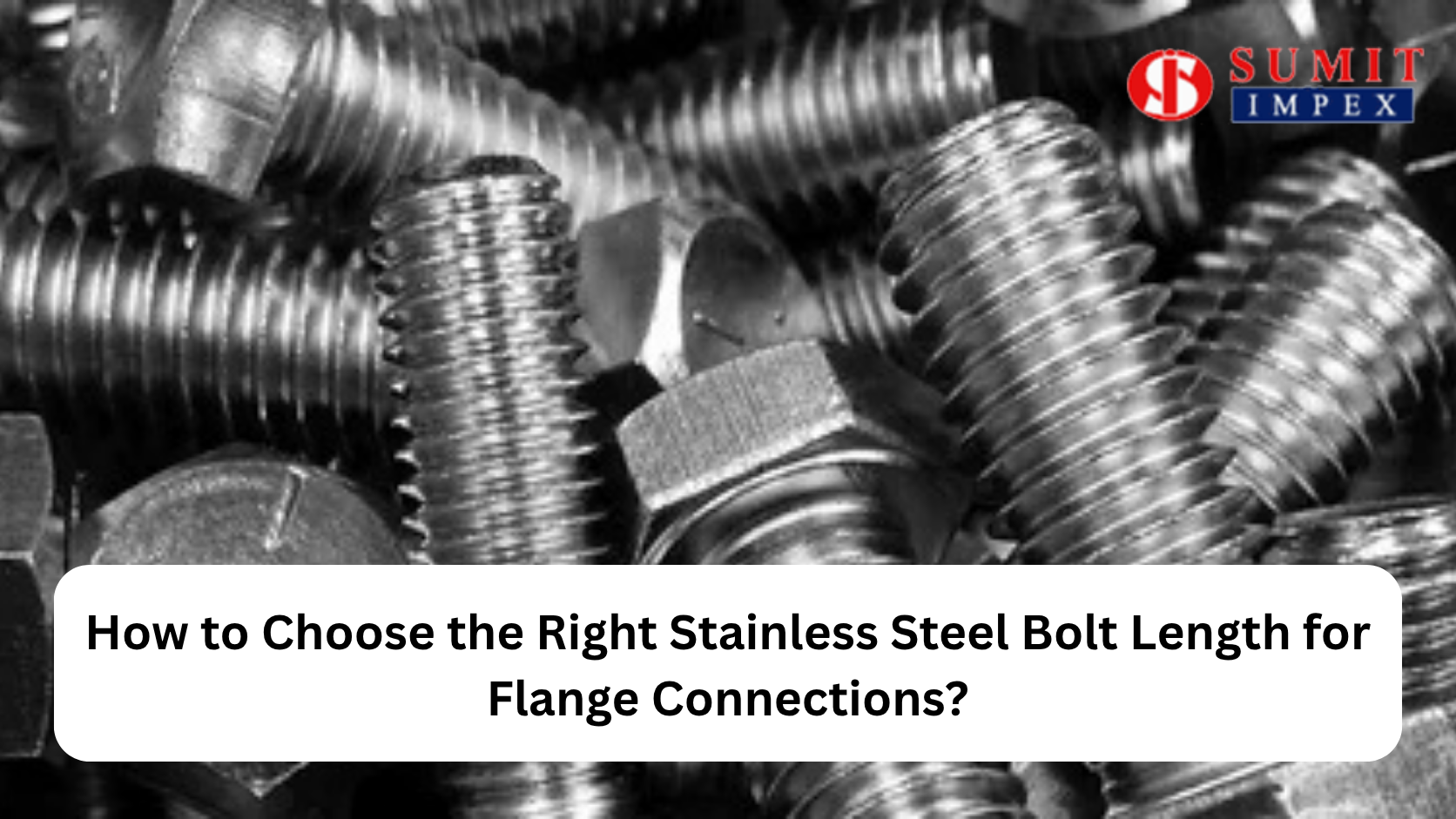
Flange joints frequently break due to a wrong bolt length compared to a bad gasket. Stainless steel bolts hold two flange faces together under load, and the length decides whether that joint seals or leaks once pressure comes on. Too short, and thread engagement lacks a safe margin. Too long, and gasket compression turns uneven across the bolt circle. This guide walks through how procurement and engineering teams actually work out bolt length for flange joints without depending on trial fitting at site.
Why Bolt Length Matters in Flange Connections
Bolts do not seal a flange joint directly. They clamp two flange faces against a gasket, and the gasket does the actual sealing work under that load. Thread engagement decides how much load a bolt carries before it strips or the nut returns under vibration.
A bolt cut too short leaves only partial threads inside the nut, cutting real engagement to a fraction of the nut height. One that runs too long bottoms out against the flange bore or leaves excess thread past the nut, throwing off torque readings during tightening. Either error reduces gasket compression somewhere around the bolt circle.
Factors to Consider When Choosing Stainless Steel Bolt Length
Getting the right Stainless Steel Bolt Length comes down to measuring the full stack, not guessing from a catalog diameter.
Flange Thickness
Measure both flange faces before ordering, not just one. Slip-on, weld-neck, and lap-joint flanges carry different hub thicknesses even within the same pressure class, so a spec sheet number is a starting point, not a final answer. Thicker hubs need longer bolts, and getting this wrong throws off the rest of the calculation.
Gasket Thickness
Gasket thickness adds to the stack height, and skipping this step is the most repeated length error on record orders. Spiral wound gaskets run close to 3.2 mm thick, while full face rubber gaskets can reach 6 mm or more. That difference alone can push a bolt from adequate to marginal thread engagement.
Nut and Washer Requirements
Standard heavy hex nuts need close to one full bolt diameter in engagement length, and this has to be added on top of the flange and gasket stack. Washers, where used, add their thickness again. Miss this step and the bolt comes up short by the exact height of the washer.
Required Thread Engagement
Full thread engagement means the internal and external threads share load across the whole nut height, not just the top few threads. Stainless bolts work harden during tightening and create more friction than carbon steel, so a short bolt strips faster under torque. Piping projects commonly leave two to three threads exposed above the nut once tightened.
Pressure Rating and Flange Standard
ASME B16.5 flange classes such as 150, 300, and 600 change hub thickness and bolt circle diameter at the same nominal pipe size. Higher classes require more bolts, larger diameters, or both, shifting the length needed for engagement. Match the bolt to the exact flange class and schedule.
Material and Application Environment
Service temperature and exposure to chlorides or acids decide which stainless grade works best, narrowing the length options worth stocking. A4 – 80 (316) bolts handle marine and chemical exposure that A2-70 (304) cannot. High-strength bolting sometimes calls for precipitation-hardened grades such as 17-4 PH, which reach higher tensile strength through heat treatment, not cold working.
Bolt Length Calculation Tips
Add flange thickness on both sides for through bolting, gasket thickness, washer thickness, and nut height, then add two to three thread pitches for exposed thread beyond the nut. Round the result up to the nearest stock length. Confirm the figure against actual measured flange dimensions, since as-built flanges can differ from drawings by a few millimeters.
Common Mistakes to Avoid
Diameter gets most of the attention during ordering, and length becomes an afterthought. That is backwards. A bolt with the correct diameter but the wrong length still fails to seat properly against the nut and stack of gaskets.
Avoiding gasket thickness in the calculation is the most common error across recurring orders, especially once gasket type changes between projects. Insufficient thread engagement compromises a joint under vibration or thermal cycling, even if it holds during initial tightening. Oversized bolts bottom out in blind holes or leave a wide thread that wrenches read wrong, and mixing grades, such as A2 studs with A4 nuts, sets up excessive and inconsistent force across the bolt circle.
Applications of Stainless Steel Bolts in Flange Connections
Oil and gas pipelines use stainless bolts at flange joints exposed to sour service and weather. Chemical plants rely on A4 grade bolts wherever flanges carry acids or caustic media that corrode carbon steel fast.
Water treatment plants specify stainless fasteners for flanges that stay submerged or splashed, since carbon steel corrosion allowances add maintenance costs. Food and beverage lines need corrosion resistance plus washdown tolerance against cleaning chemicals. Marine flanges face salt spray daily, and power plants use stainless bolting on steam lines where carbon steel scales and loses strength.
How to Select a Reliable Stainless Steel Bolt Supplier
- Verify material certifications: mill test certificates confirming grade, heat number, and mechanical properties should come with every batch.
- Check available sizes and grades: a supplier stocking A2-70, A4-80, and 17-4 PH across common diameters avoids project delays.
- Ensure compliance with ASTM/ASME standards: fasteners should reference ASTM A193, A320, or an equivalent spec matched to the flange class.
- Confirm quality testing: ask for proof load test reports or hardness records on critical service orders.
- Evaluate stock availability and delivery support: depth of stock in common sizes cuts lead time on repeat orders.
Conclusion
Bolt length decides whether the joint holds pressure across its service life without leaking or loosening under vibration. Flange thickness, gasket thickness, nut height, and thread engagement need to be right before ordering, or the guesswork shows up later as a leak.
A correct bolt length guide, matched to ASME flange class and gasket type, keeps sourcing across repeat projects. Sumit Impex supplies stainless steel bolts across standard grades and lengths, with stock ready in common sizes. Reach out to confirm dimensions and lead time at Sumit Impex.
Related Posts