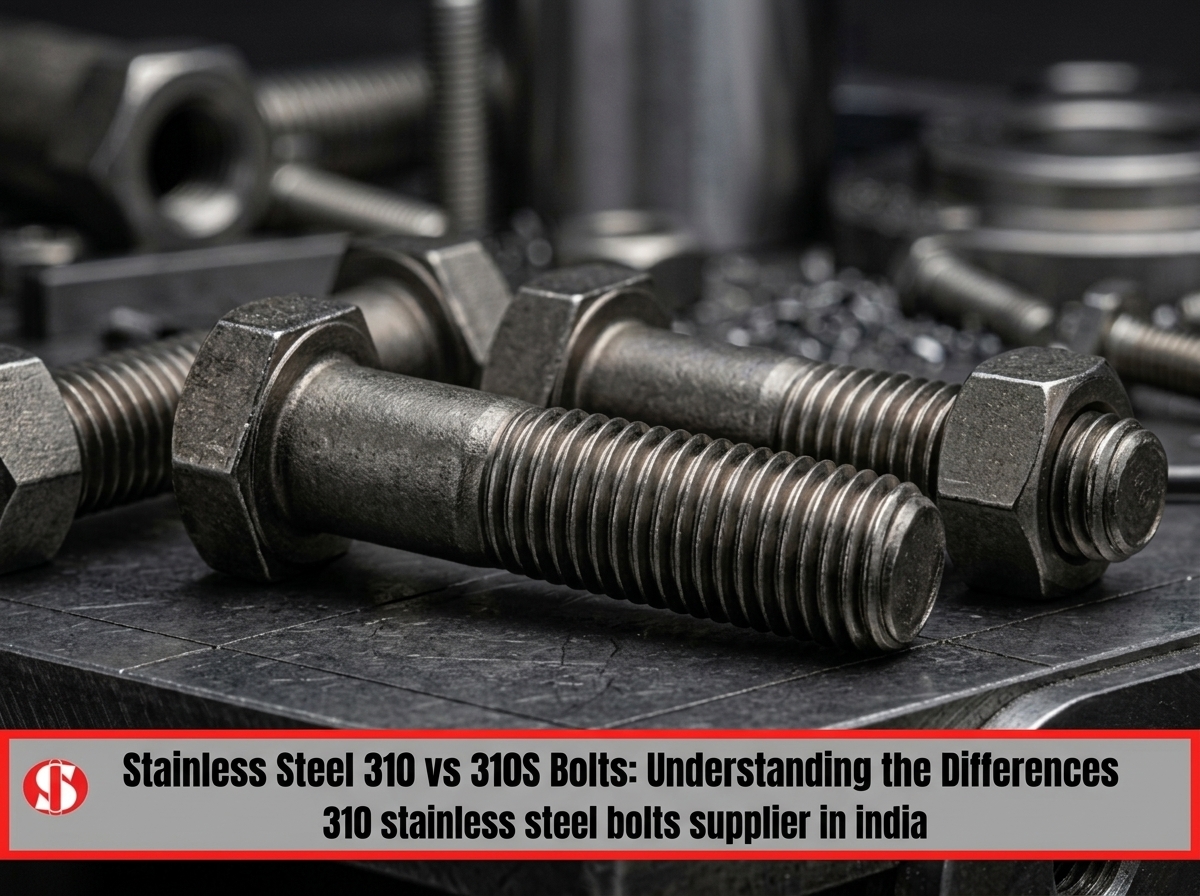
A bolt that deteriorates at elevated temperatures shears, warps, or seizes, and the flange joint or furnace assembly has to face the consequences of it. Heat-resistant fasteners exist because standard grades like 304 or 316 lose strength and oxidation resistance well before industrial process temperatures are reached. This is where SS 310 and SS 310S bolts come into the picture.
Sumit Impex, based in Mumbai, supplies both grades to fabricators, EPC contractors, and process plants working in high-temperature service. As a 310 stainless steel bolts supplier in India, we focus on questioning which grade actually fits the application. The answer depends on fabrication method, service temperature, and whether the bolt sits in a welded or bolted-only joint. Both belong to the austenitic stainless steel family, rated for continuous elevated-temperature service up to roughly 1150°C in oxidizing atmospheres. The difference comes down to a single element: carbon.
Why SS 310 and SS 310S Bolts Are Often Compared
SS 310 and SS 310S share nearly identical base chemistry. Both carry 24-26% chromium and 19-22% nickel, resisting scaling and oxidation at temperatures that would destroy a martensitic or ferritic grade in weeks. That alloy content makes both grades default choices for furnace hardware, heat-treatment fixtures, and burner assemblies.
310S is not a separate grade in the way 316 differs from 304. It is a controlled-carbon variant of 310, developed for welded fabrication. Chromium and nickel levels stay essentially the same across both. What changes is the maximum carbon content, and that shift affects weld integrity and long-term corrosion behavior.
The Role of Carbon Content in Bolt Performance
Carbon content draws the line between these two grades. SS 310 allows carbon up to 0.25%, while SS 310S caps it at 0.08%. That threefold difference sounds small on paper. In practice, it governs how each grade behaves under heat.
Higher carbon in SS 310 contributes to elevated-temperature strength and creep resistance. It also raises the risk of carbide precipitation at grain boundaries when the material heats between 450°C and 850°C, a range that welding routinely passes through. Chromium carbides form along these boundaries, pulling chromium from the surrounding matrix and leaving it vulnerable to intergranular corrosion. This process, sensitization, weakens the region near a weld.
SS 310S limits this risk. Lower carbon content restricts carbide formation during welding, so chromium stays distributed through the matrix instead of concentrating in unwanted precipitates. That is why 310S welds hold up better in service and why fabricators specify it for assemblies that see heat during construction as well as operation. Weldability, not raw strength, decides the choice here.
SS 310 vs SS 310S Bolts: Comparison Table
Parameter | SS 310 | SS 310S |
| Carbon Content | Up to 0.25% | Up to 0.08% |
| Weldability | Moderate; sensitization risk in HAZ | Strong; low sensitization risk |
| High-Temperature Strength | Higher creep and stress-rupture strength | Slightly lower creep resistance |
| Oxidation Resistance | Excellent up to 1150°C | Excellent up to 1150°C |
| Sensitization Resistance | Lower | Higher |
| Thermal Cycling Performance | Good in non-welded assemblies | Better in welded, cyclic-load assemblies |
| Corrosion Resistance | Strong in oxidizing atmospheres | Strong, with better post-weld corrosion resistance |
| Typical Applications | Furnace internals, heat-treat fixtures | Welded furnace structures, boiler components |
| Best Suited For | Non-welded, high-strength bolted joints | Fabricated and welded assemblies |
Choosing Between SS 310 and SS 310S for High-Temperature Service
Both grades handle continuous exposure above 1000°C without significant scaling due to their chromium-nickel ratio. Oxidation resistance alone will not separate one from the other in most furnace or kiln applications; either grade forms a stable protective oxide layer.
The deciding factor shifts to how the bolt reaches service temperature and how often it cycles. A bolted joint that is machined, torqued, and left in place benefits from the higher strength of SS 310. An assembly welded into place, or one that heats and cools repeatedly during batch processing, puts more stress on the heat-affected zone, favoring SS 310S. Long-term reliability tracks back to the likelier failure mode: strength loss under sustained load, or intergranular attack near a weld.
Where Stainless Steel 310 Bolts Offer an Advantage
Furnace equipment, burner assemblies, and heat-treatment systems relying on bolted rather than welded connections gain the most from SS 310. Higher carbon content translates into better creep resistance under sustained mechanical load at temperature, a property that matters in kiln rollers, radiant tube supports, and heat-treat basket hardware.
Severe thermal environments, where the bolt experiences the full process temperature, also favor SS 310. High-temperature assemblies running near the upper limit of austenitic stainless steel capability get more service life out of the 310 grade’s elevated-temperature strength.
When Stainless Steel 310S Bolts Become the Better Choice
Fabricated assemblies and welded structures shift the calculation toward SS 310S. Components exposed to repeated thermal cycles, particularly those passing through the 450°C to 850°C sensitization window on every heat-up and cool-down, benefit from reduced carbide precipitation.
Equipment requiring resistance to sensitization, including welded boiler components, refinery process vessels, and multi-piece furnace structures assembled on site, holds up longer with SS 310S at the joint. The trade-off in peak strength is minor next to the corrosion protection gained near every weld seam.
Industries That Commonly Use SS 310 and 310S Fasteners
Petrochemical plants specify both grades for reactor internals and furnace hardware exposed to sustained process heat. Power generation facilities use them in boiler supports and superheater assemblies. Heat treatment facilities rely on stainless steel 310 fasteners for basket and fixture hardware cycling through repeated furnace loads.
Refineries select between the two grades depending on whether the joint is bolted or welded. Thermal processing industries, including glass and ceramics manufacturing, use both across kiln hardware and conveyor systems, where oxidation resistance decides service life more than initial cost.
Factors to Evaluate Before Selecting SS 310 or 310S Bolts
Service temperature comes first. Confirm the operating range and how much time the bolt spends in the 450°C to 850°C window during startup, shutdown, or normal cycling. Welding requirements follow directly: any assembly requiring on-site or shop welding near the fastener location points toward SS 310S.
Corrosion conditions in the surrounding atmosphere, whether oxidizing, sulfidizing, or carburizing, affect which grade holds up longer at a given site. Check applicable standards, such as ASTM A193 or A194 for bolting material, against project engineering requirements before ordering. Bolt dimensions, including thread size, length, and head style, should be verified against the drawing package rather than assumed from a previous order.
Conclusion
SS 310 and SS 310S share the same chromium-nickel foundation but diverge on carbon content, and that difference decides where each grade performs best. SS 310 delivers higher elevated-temperature strength for non-welded, bolted assemblies in severe thermal environments. SS 310S trades a small amount of peak strength for better weldability and sensitization resistance, making it the stronger choice for fabricated and welded structures.
Neither grade replaces the other across the board. The right stainless steel 310 bolt or 310S fastener depends on service temperature, fabrication method, and corrosion conditions at the installation site. Confirm these details against project specifications before finalizing an order.
Related Posts